01
Licensed in your state
Every letter is signed by a mental health professional licensed where you live, with license details a landlord can verify.
Get a legitimate ESA letter online from a licensed mental health professional in your state. A real telehealth evaluation, documentation landlords can verify, and your letter right after your consultation if you qualify.
Medically reviewed by Dr. Johnathan Miller, M.D.Updated October 9, 2026
Short version: an ESA letter is still housing documentation, and housing is still where it works. Federal enforcement shifted this year, so here is the current status, item by item.
How HUD’s May 2026 memo changed enforcement →No waiting rooms and no weeks-long waitlists. You get a real evaluation by a real mental health professional, on your schedule, from your phone or laptop.
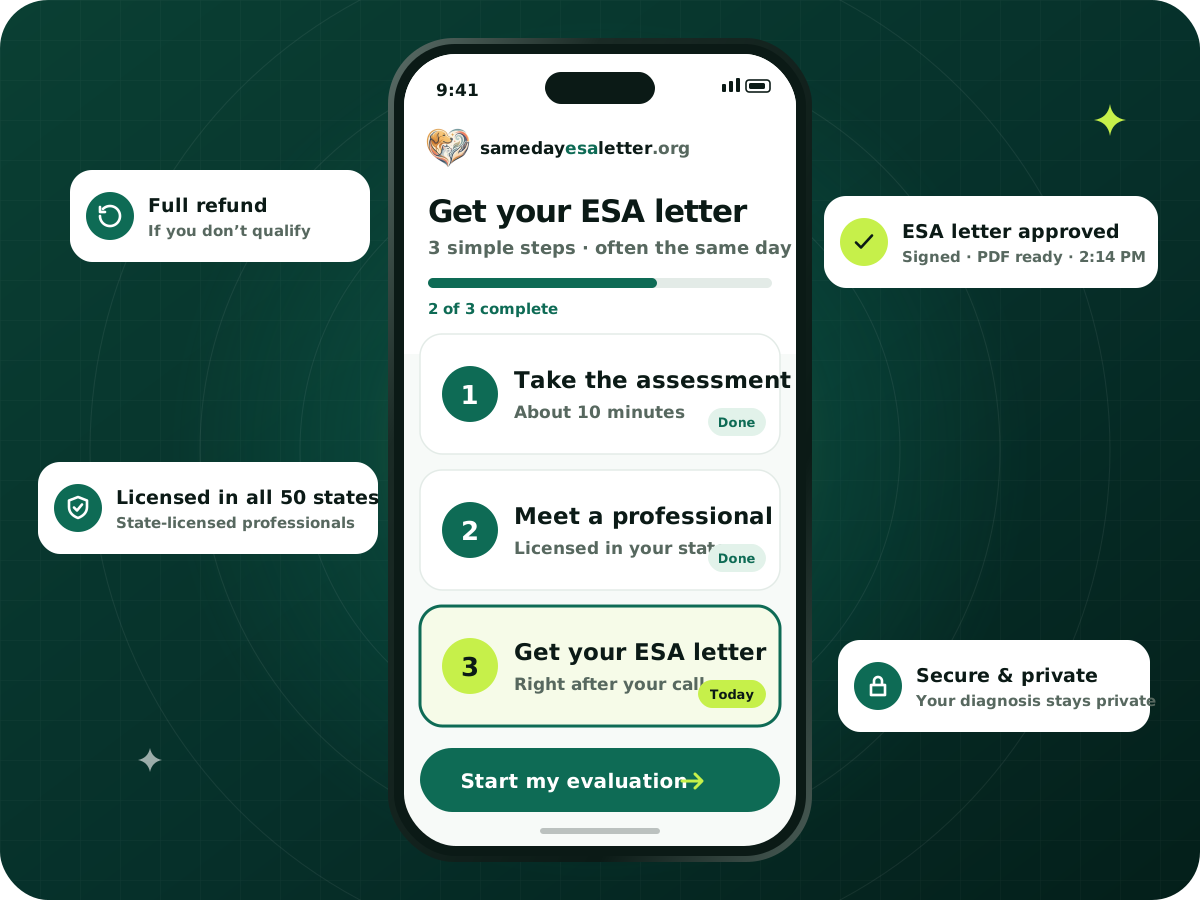
Answer a short, confidential questionnaire about how your symptoms affect daily life. It takes about 10 minutes from any device.
An independent mental health professional licensed in your state reviews your answers and, when needed, follows up by secure telehealth.
If you qualify, your signed ESA letter is issued right after your video or phone consultation and emailed as a PDF.
Every letter is written and signed by the mental health professional who evaluated you. Here’s what a housing provider sees when you hand it over.
Name and contact details of the mental health professional who evaluated you.
License type, number and issuing state, so the letter can be checked.
Confirms a disability and a disability-related need for your animal, without naming your diagnosis.
Signed and dated on the day your evaluation is complete.
What you won’t find on it: a “registration number,” a certificate seal or an ID card. No law calls for them, so we don’t make them.
Landlords and property managers have gotten much better at spotting weak ESA paperwork. We focus on documentation that holds up: written by licensed professionals after a genuine evaluation.
Every letter is signed by a mental health professional licensed where you live, with license details a landlord can verify.
Most approved clients receive their letter the same day. Waiting-period states like California are handled by the book.
Letters include what state laws, agencies and courts look for, updated for HUD’s 2026 changes.
Your letter confirms your need for an ESA without revealing your diagnosis. Data is encrypted end to end.
If the mental health professional determines you don’t qualify, you get your money back. No questions asked.
Mental health professionals answer legitimate verification requests, so your accommodation request isn’t left hanging.
Qualifying isn’t about a particular label. A licensed mental health professional looks at how your symptoms affect daily life and whether your animal eases them. These are the conditions we see most often.
No diagnosis yet? You can still be evaluated. Many people put a name to what they’re experiencing for the first time during the assessment.
An ESA letter is a signed letter from a licensed mental health professional confirming that you have a mental or emotional disability and that your emotional support animal helps relieve one or more of its symptoms. When your disability isn’t obvious, it’s the documentation a landlord, HOA or campus housing office can ask for before approving a reasonable accommodation, such as an exception to a no-pet rule.
Once an accommodation is approved, standard pet rules on size, weight, breed and fees generally don’t apply the same way, though the details vary by state. You’re still responsible for your animal’s behavior and for any real damage.
The federal Fair Housing Act still requires reasonable accommodations for people with disabilities. What changed is enforcement: HUD has withdrawn its 2020 assistance-animal guidance, and since a May 22, 2026 memo it generally pursues federal complaints only for animals individually trained to help with a disability. Private lawsuits remain available, and many states, including Florida, Illinois, Minnesota, Virginia and Wisconsin, have their own laws covering emotional support animals. That makes a well-documented letter from a mental health professional licensed in your state more important than ever. Check your state’s page for the rules where you live.
An ESA letter doesn’t give your animal access to stores, restaurants or other public places, and U.S. airlines are no longer required to accept ESAs in the cabin. Those rights belong to individually trained service animals. We’ll never sell you vests, ID cards or “registrations,” because none of them have legal standing.
Your state’s own fair-housing law now does much of the work federal enforcement used to. Some states protect emotional support animals by name, some set documentation rules, and a few require a client relationship before certain letters. Select your state on the map to open its guide.
ESA scams cost renters money and can sink a housing request. Here’s the checklist we’d give a friend before they paid anyone, us included.
ESA letters cost $129 for up to 2 pets or $199 for 3 or more. No subscriptions and no surprise add-ons, plus a full refund if you don’t qualify.
An ESA letter protects your right to live with a comfort animal. A psychiatric service dog is individually trained to perform tasks, and that training is what gives it broader rights.
| ESA Letter | PSD Letter | |
|---|---|---|
| Who it’s for | People whose animal provides comfort that relieves symptoms of a mental or emotional disability | People whose dog is individually trained to perform tasks related to a psychiatric disability |
| Animals covered | Dogs, cats and other common household animals | Dogs only (ADA definition of service animal) |
| Housing | Protected by many state laws; federal enforcement narrowed in May 2026 | Yes — trained dogs remain the focus of federal (HUD) enforcement |
| Public places (ADA) | No public-access rights | Yes — when the dog is task-trained and under control |
| Air travel (DOT) | Airlines may treat ESAs as pets | Accepted with the airline’s DOT service animal form |
| Training required | No | Yes — the dog must be trained to perform specific tasks |
There is no official national ESA registry, and online “registrations,” ID cards and certificates carry no legal weight. Registering your emotional support animal with your housing provider means giving them reliable documentation and a written accommodation request.
Every ESA evaluation is completed by a mental health professional licensed in the patient’s state, after a genuine telehealth evaluation.
Medical Doctor (M.D.)
Physician on our team who completes ESA evaluations and helps patients understand how their letter works for housing.
Mental health professionalMedical Doctor (M.D.)
Physician on our team who completes ESA evaluations and explains each patient's documentation and next steps clearly.
Mental health professionalWe work with mental health professionals licensed across the U.S. Start with a popular city or browse all 50 states.
 New York City, NYNew York-licensed mental health professionals
 Los Angeles, CACalifornia-licensed mental health professionals
 Chicago, ILIllinois-licensed mental health professionals
 Houston, TXTexas-licensed mental health professionals
 Miami, FLFlorida-licensed mental health professionals
 Phoenix, AZArizona-licensed mental health professionals
 Seattle, WAWashington-licensed mental health professionals
 Atlanta, GAGeorgia-licensed mental health professionals
No subscription, no “expedite” upsell and no registry add-ons. Have three or more animals? It’s $199, everything else the same.
No recurring charges
An ESA letter online is a signed letter from a licensed mental health professional, issued after a telehealth evaluation, confirming that you have a disability and a disability-related need for an emotional support animal. It’s the documentation a landlord, HOA or campus housing office can ask for when your disability isn’t obvious.
Yes, when it comes from a mental health professional licensed in your state after a genuine evaluation. What isn’t legitimate are instant certificates, registrations and ID cards sold without any evaluation. Landlords can verify a real letter’s license details.
Most people finish the assessment in about 10 minutes. In most states, if the mental health professional approves you, your ESA letter is issued right after your video or phone consultation. California and Arkansas (for emotional support dogs) and Iowa, Louisiana and Montana require a 30-day client relationship for certain letters. We follow that rule, and for urgent housing your mental health professional can issue an ESA Letter of Intent right after your consultation.
In states with a 30-day rule (California and Arkansas for emotional support dogs; Iowa, Louisiana and Montana for ESA housing documentation), your full ESA letter can only be issued once the 30-day relationship is complete. For urgent housing needs, your mental health professional can issue an ESA Letter of Intent right after your consultation. It confirms you’ve started care with a professional licensed in your state and the date your full letter can be issued. You can share it with a landlord while you wait; acceptance is up to the housing provider, and your full ESA letter follows when the 30 days are complete.
No. There is no official government registry for emotional support animals, and no legitimate certificate or ID card. Any site selling registration or certification is selling a document with no legal standing. The only document that carries weight is a letter from a licensed mental health professional who has actually evaluated you.
No document can guarantee that. A valid letter supports a reasonable accommodation request under the Fair Housing Act and many state laws, and most landlords accommodate a well-documented request. Landlords may deny in narrow cases, such as a specific animal that poses a direct threat.
Since January 2021, U.S. Department of Transportation rules no longer require airlines to accept emotional support animals, so most airlines treat them as pets. Individually trained psychiatric service dogs are different and may fly with the DOT service animal form.
A licensed mental health professional, such as a psychiatrist, psychologist, licensed clinical social worker or licensed counselor, who is licensed in your state and has evaluated you. Some states add their own requirements, such as a 30-day client relationship.
Our ESA letter is $129 for up to two animals, or $199 for three or more. It’s a one-time fee that includes the evaluation and your letter, with a full refund if you don’t qualify.
You receive a full refund. Your mental health professional will explain their reasoning and, where helpful, suggest other kinds of support that may fit your situation better.
HUD has withdrawn its 2020 assistance-animal guidance, and in a May 22, 2026 memo it narrowed federal enforcement to animals individually trained to help with a disability. The Fair Housing Act didn’t change, private lawsuits remain available, and many state laws still protect emotional support animals.

Start the assessment now and get your letter right after your consultation with a licensed mental health professional if you qualify.
Keep reading
References
Last reviewed October 9, 2026. General information, not legal or medical advice.
Answer five quick questions to see whether an ESA evaluation is a good next step. It takes about a minute and nothing is saved.