Dr. Gaurav Patel, M.D.
Medical Doctor (M.D.)
Physician on our team who completes ESA evaluations and helps patients understand how their letter works for housing.
Mental health professionalSouth Carolina is one of the few states whose own fair housing law spells out what documentation a landlord may request for an assistance animal, and its civil rights agency has said that standard still protects emotional support animals after HUD's 2026 policy change. We connect South Carolinians with independent mental health professionals licensed in South Carolina for an honest evaluation.
Medically reviewed by Dr. Johnathan Miller, M.D.Updated October 9, 2026
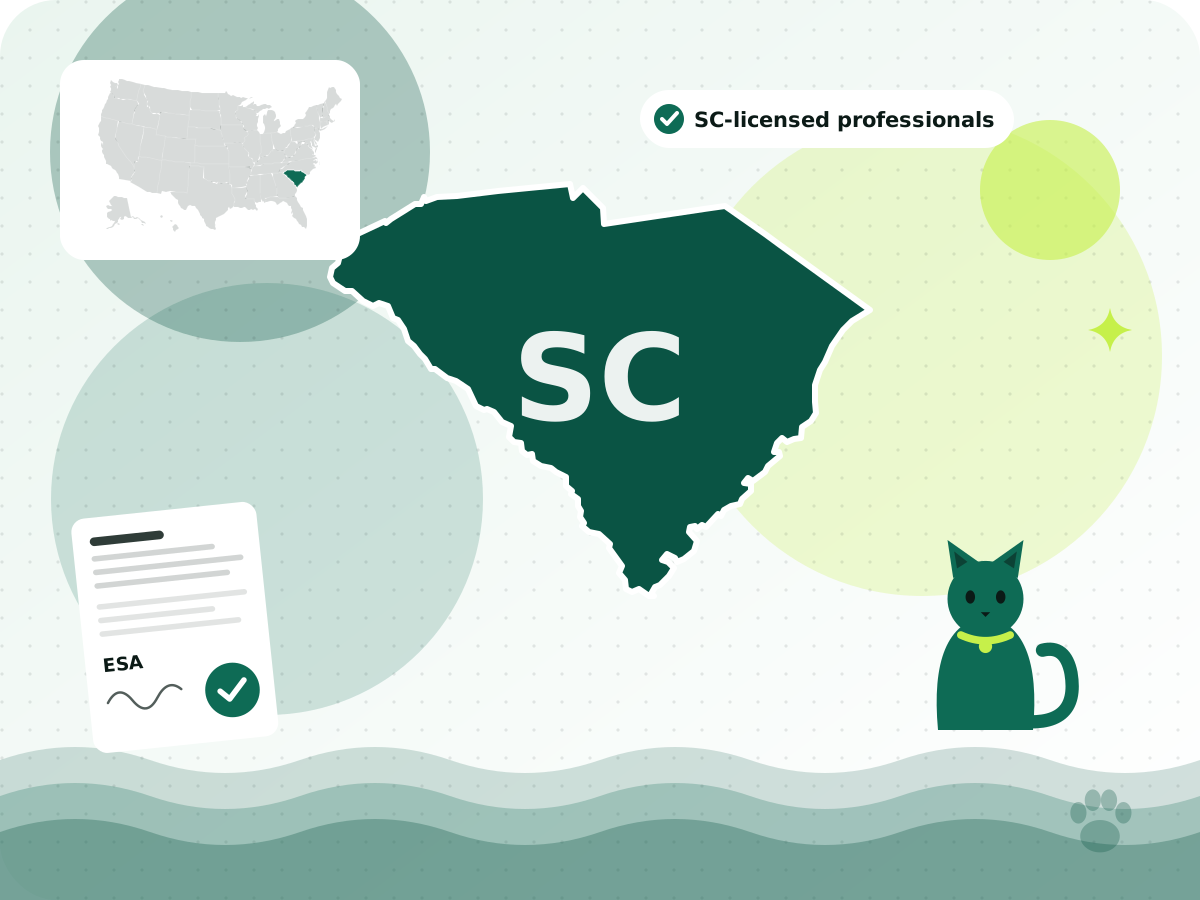
The South Carolina Fair Housing Law (S.C. Code Ann. §31-21-10 et seq.) prohibits housing discrimination based on disability and requires reasonable accommodations, alongside the federal Fair Housing Act. Complaints are handled by the South Carolina Human Affairs Commission (SCHAC), which accepts fair housing complaints by phone, online and by mail.
South Carolina's law matters even more after 2026. On May 22, 2026, HUD issued an enforcement memo confirming the withdrawal of its 2020 assistance-animal guidance (FHEO-2020-01) and directing its fair housing office to pursue federal cases only where the animal is individually trained to perform disability-related tasks. In response, SCHAC announced that South Carolina's own protections are unchanged: §31-21-70(N) sets an independent documentation standard that does not require an animal to be individually trained. In SCHAC's words, HUD changed how it enforces federal law, not what South Carolina law requires. South Carolinians denied an accommodation for an emotional support animal can still file with SCHAC or go to state court.
In 2019, South Carolina passed Act No. 44, which updated both housing and public accommodation rules for animals. In housing, the Act amended §31-21-70 so that a landlord may ask two questions: whether the person seeking to live with the animal has a disability (a physical or mental impairment that substantially limits one or more major life activities), and whether the person has a disability-related need for the animal. The landlord may request documentation verifying those answers, and documentation is sufficient if it establishes that the person has a disability and that the animal provides disability-related assistance or emotional support.
The same Act created §47-3-980, which makes it unlawful to knowingly misrepresent an animal that is not a service animal, such as a pet or emotional support animal, as a service animal to obtain a disability-related right or privilege. A violation is not a criminal offense, but it carries fines of up to $250 for a first offense, up to $500 for a second and up to $1,000 for a third or later offense. The Act also clarifies that emotional support, comfort and companionship are not service animal "work or tasks."
South Carolina has no waiting period for ESA letters, so your letter can be issued the same day your South Carolina-licensed mental health professional approves you. It will include the mental health professional's name, license type, South Carolina license number, the date, and a statement of your disability and the animal's disability-related support, without naming your diagnosis.
Charleston, Mount Pleasant and Summerville have fast-growing suburbs with many HOA communities and condo associations, and Hilton Head and Myrtle Beach have large condo and villa complexes. Those associations often have pet size, breed and number limits, which can be modified as a reasonable accommodation for a resident with a disability. Along the Grand Strand and on the barrier islands, many units are weekly vacation rentals, which are generally not treated like a home lease.
College towns are a big part of the market. The University of South Carolina in Columbia, Clemson University, the College of Charleston, Furman in Greenville, Winthrop in Rock Hill and Coastal Carolina in Conway each have their own process for animals in campus housing, usually through student disability services.
South Carolina also has a large military presence: Fort Jackson in Columbia, Shaw Air Force Base near Sumter, Joint Base Charleston, MCAS Beaufort and Parris Island. Privatized base housing uses its own accommodation process. Finally, the coast is hurricane country. Know your evacuation zone, keep a carrier, leash, food, medications and vaccination records ready, and look for pet-friendly shelters in your county before storm season.
South Carolina law, as updated by Act 44, defines service animals as dogs or miniature horses trained to do work or perform tasks for a person with a disability, consistent with the ADA. A psychiatric service dog might interrupt panic attacks, provide tactile grounding or alert a handler to rising anxiety. Its public access comes from that training. A letter does not create public access rights, and presenting a pet or ESA as a service animal can lead to fines under §47-3-980.
A PSD letter from a South Carolina-licensed mental health professional documents your disability-related need for a trained service dog. It supports housing requests and can help you complete the U.S. DOT Service Animal Air Transportation Form for flights out of Charleston, Columbia, Greenville-Spartanburg or Myrtle Beach. Airlines have not been required to accept emotional support animals since 2021.
If a housing provider refuses a reasonable accommodation without a valid reason, you can contact South Carolina Human Affairs Commission, a local fair housing organization, or a housing attorney. Deadlines apply, so act promptly.
Last reviewed: October 9, 2026. Laws change; this page is general information, not legal advice.
There is no official national ESA registry, and online “registrations,” ID cards and certificates carry no legal weight. Registering your emotional support animal with your housing provider means giving them reliable documentation and a written accommodation request.
Every ESA evaluation for South Carolina residents is completed by a mental health professional licensed in the patient’s state, after a genuine telehealth evaluation.
Medical Doctor (M.D.)
Physician on our team who completes ESA evaluations and helps patients understand how their letter works for housing.
Mental health professionalMedical Doctor (M.D.)
Physician on our team who completes ESA evaluations and explains each patient's documentation and next steps clearly.
Mental health professionalEach pin sits on the city’s real location, and each list entry shows the outline of its county. Because the visit happens by video or phone, the SC-licensed professional you meet can help you just the same in Charleston as in Spartanburg, or anywhere in between.
According to SCHAC, yes. The South Carolina Human Affairs Commission said that §31-21-70(N) of the state Fair Housing Law sets an independent documentation standard that does not require an animal to be individually trained, and that HUD's memo changed federal enforcement, not South Carolina law.
Under §31-21-70, a landlord may ask whether you have a disability and whether you have a disability-related need for the animal, and may request documentation verifying those answers. They may not demand your diagnosis or full medical records.
Documentation is sufficient if it establishes that you have a disability and that the animal provides disability-related assistance or emotional support. A letter from a licensed mental health professional who evaluated you covers both points.
No. South Carolina has no waiting period or minimum relationship requirement, so your letter can be issued the same day your mental health professional approves you.
Under §47-3-980, added by Act 44 of 2019, knowingly misrepresenting an animal that is not a service animal, such as a pet or ESA, as a service animal to obtain a disability-related right or privilege is a non-criminal violation with fines of up to $250 for a first offense, $500 for a second and $1,000 for a third or later.
With the South Carolina Human Affairs Commission (SCHAC), by phone, online or by mail. You can also go to state court or file with HUD.
Yes, you can request a reasonable accommodation to the weight limit for a disability-related need. The association may deny only for narrow reasons, such as a direct threat from your specific animal.
Each university has its own process for animals in campus housing through its student disability services office. Contact them early and follow their requirements.
Privatized military housing has its own accommodation procedures. Ask the housing office for its form and submit your mental health professional's letter with it.
Short-term vacation rentals are generally not treated like a residential lease, so ESA accommodation rules may not apply the same way. Look for pet-friendly rentals.
Once your animal is approved as a disability accommodation, the landlord should not charge pet fees, pet rent or a pet deposit. You are still responsible for any actual damage.
Plan ahead: know your evacuation zone, keep a carrier, leash, food, medications and vaccination records ready, and find pet-friendly shelters or lodging in advance.
$129 for up to two animals or $199 for three or more. You receive a full refund if the mental health professional determines you don't qualify.
No. There is no official ESA registry, and those products carry no legal weight in South Carolina. We provide mental health professional-signed letters only.
Pick a time that suits you; booking is open 24/7.
About 10 minutes of questions about how you’ve been feeling.
Video or phone. Your signed letter by email right after the call, if you qualify.
From$129up to 2 animals · $199 for 3 or more
Book my evaluationCheck if I qualify firstA South Carolina-licensed mental health professional makes the decision after a real evaluation. If you don’t qualify, you get a full refund.
Keep reading
Answer five quick questions to see whether an ESA evaluation is a good next step. It takes about a minute and nothing is saved.