Dr. Gaurav Patel, M.D.
Medical Doctor (M.D.)
Physician on our team who completes ESA evaluations and helps patients understand how their letter works for housing.
Mental health professionalFederal fair housing law still lets people with disabilities ask for exceptions to pet rules, but HUD changed how it enforces those rules for emotional support animals in May 2026. Here is where things stand and where to go next.
Medically reviewed by Dr. Johnathan Miller, M.D.Updated October 9, 2026
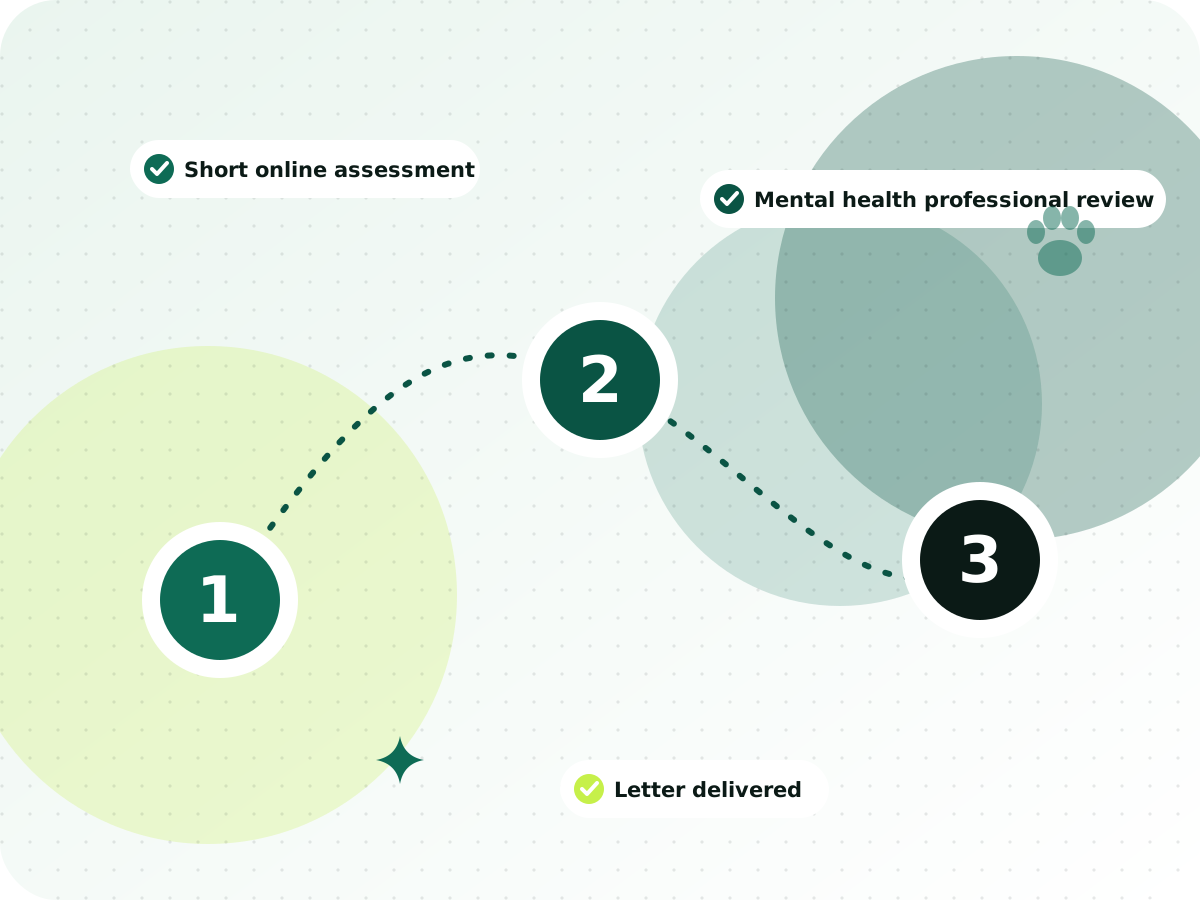
For years, emotional support animal (ESA) housing rights rested on two pillars: the federal Fair Housing Act (FHA), which requires housing providers to make reasonable accommodations in their rules for people with disabilities, and HUD guidance that told landlords how to apply that duty to animals. In 2026 one of those pillars moved.
On May 22, 2026, HUD's Office of Fair Housing and Equal Opportunity issued an enforcement memo confirming the permanent rescission of its 2020 assistance-animal notice (FHEO-2020-01) and reconfirming that both that notice and its 2013 assistance-animal notice (FHEO-2013-01) were rescinded on September 17, 2025. HUD now says it will generally find reasonable cause of a violation only when an animal is individually trained to do work or perform tasks related to a person's disability. Comfort or companionship alone no longer gets an ESA owner the benefit of HUD's enforcement.
What did not change matters just as much. The Fair Housing Act itself and its regulations were not amended. People can still bring private lawsuits in federal or state court, generally within two years. And state and local fair housing laws, many of which protect ESAs, are unaffected. Our full explainer on HUD's 2026 guidance walks through the details.
An ESA is not a pet exception you claim; it is an accommodation you ask for. Under 42 U.S.C. § 3604(f)(3)(B), it is unlawful to refuse reasonable accommodations in rules, policies, practices, or services when they may be necessary to give a person with a disability an equal opportunity to use and enjoy a dwelling. In practice, that means:
Our step-by-step guide to writing a reasonable accommodation request includes what to say and what to keep private.
When a disability or the need for an animal is not apparent, a housing provider can generally ask for reliable information that confirms both. That is where an ESA letter fits. What a provider should not need is your private medical history. Florida's law, for example, says a housing provider may not request information that discloses the diagnosis or severity of a person's disability or any medical records, and may not require a specific form or a notarized statement. Many other states follow similar principles, though the details vary.
Since HUD's 2026 memo, some providers may also ask whether an animal has been trained to perform a specific task. You are not required to invent training your animal does not have. Be truthful; if your animal is an untrained ESA, your strongest protections may come from state law or from the FHA through a private claim rather than from HUD enforcement.
Online registries, certificates, and ID cards are a different story. Florida's statute states that an ESA registration, including one obtained from the internet, is not by itself sufficient to establish a disability. Learn why in ESA certification vs. ESA letter.
A no-pet policy is exactly the kind of rule an accommodation request asks a provider to bend, so a no-pets lease is not by itself a reason to deny an ESA. Read more in ESAs and no-pet policies.
Fees are where the 2026 change bites hardest. Some states ban them outright for ESAs: Florida's statute says a person with an ESA may not be required to pay extra compensation for the animal. Outside states with a law or agency rule like that, pet fees generally should not apply once an accommodation is approved, but rules vary and some courts have held that waiving fees is not always required. You remain responsible for any damage your animal causes. See ESA pet rent and deposits for more.
Even before 2026, an accommodation was never automatic. A housing provider could deny a request when, for example:
Now, with HUD focused on trained animals, some providers may deny untrained ESAs more readily. A denial is not necessarily lawful, especially in states that protect ESAs. Our guide to what to do if your landlord denied your ESA covers next steps.
The same basic accommodation framework reaches beyond apartments. The U.S. Department of Justice has taken the position that the Fair Housing Act requires universities to accommodate students who need assistance animals in university housing, and public colleges also have obligations under Section 504 of the Rehabilitation Act. See ESAs in college dorms.
Homeowners associations and condo boards set pet rules too, and those rules can be the subject of an accommodation request. New Jersey's Supreme Court addressed exactly that in a 2024 condominium case. See ESAs in HOAs and condos.
HUD's memo changes federal enforcement priorities, not state statutes. In states with their own protections, a state civil rights agency or court may still treat a denied ESA request as discrimination. Several states also regulate ESA documentation itself. California, Arkansas, Iowa, Louisiana, and Montana generally require roughly a 30-day relationship between you and the provider before an ESA letter is issued, and Florida requires that the practitioner have personal knowledge of your disability. In those states, an ESA Letter of Intent is available right after your consultation for urgent housing, and the full letter follows once the 30 days are complete. Check your state in our ESA laws by state guide.
| Guide | What it covers |
|---|---|
| HUD 2026 guidance | What HUD withdrew and what still applies |
| Accommodation requests | How to ask, step by step |
| No-pet policies | ESAs in pet-free buildings |
| Pet rent and deposits | When fees can and cannot apply |
| Landlord denials | Your options after a no |
| College dorms | University housing and Section 504 |
| HOAs and condos | Association pet rules and disputes |
Same Day ESA Letter connects you with licensed mental health professionals for an ESA evaluation. You can book online 24/7. An ESA letter is $129 for up to two animals and $199 for three or more, and you get a full refund if you are not approved. Your letter does not disclose your diagnosis, and we do not sell registries, certificates, or ID cards, because those are not what housing providers rely on. A letter supports your request; it cannot guarantee how a landlord, school, or association will decide. See pricing and how it works for details.
This page is general information, not legal advice. Laws and agency policies change, and outcomes depend on your facts and your state. For advice about a specific dispute, talk with a fair housing attorney or your local fair housing agency.
Students with disabilities can ask their school to make an exception to dorm pet rules. Here is how the law applies to university housing in 2026, how campus processes usually work, and how to plan ahead.
Read the guide →ESA housingHomeowners associations and condo boards write pet rules, and those rules can be the subject of a disability accommodation request. Here is how that works, what boards can ask, and how 2026 changed the picture.
Read the guide →ESA housingIn a May 22, 2026 enforcement memo, HUD narrowed when its own investigators will find a violation in emotional support animal cases, after formally withdrawing the guidance that shaped those requests for more than a decade. Here is what the official documents actually say, what they leave untouched, and what tenants and landlords should do now.
Read the guide →ESA housingA denial isn’t always the final word. Here’s how to tell a valid reason from an invalid one, keep the conversation going, and know your options if it doesn’t get resolved.
Read the guide →ESA housingA no-pet rule is a policy, and fair housing law allows exceptions to policies when a disability makes one necessary. Here’s how that works, where the limits are, and what changed in 2026.
Read the guide →ESA housingWhether a landlord can charge pet fees for an emotional support animal now depends more on your state than on federal guidance. Here’s where the rules stand and what to do if you’re billed.
Read the guide →ESA housingA short, well-organized request makes it easier for a landlord to say yes and gives you a clean record if they don’t. Here’s what to include, what to leave out, and a template you can adapt.
Read the guide →The Fair Housing Act's reasonable accommodation requirement has not changed, and many state laws still protect ESAs. What changed is HUD's enforcement: since May 22, 2026, HUD generally finds reasonable cause only for animals individually trained to provide disability-related help. Your protection now depends more on your state's law and, if needed, a private claim.
No. HUD has withdrawn its 2013 and 2020 guidance documents on assistance animals, but the Fair Housing Act and its regulations remain the same. HUD has said it plans to address animal accommodations through formal notice-and-comment rulemaking in the future.
Generally, a housing provider may ask for reliable information that you have a disability and a disability-related need for the animal, but not for your diagnosis or medical records. Some states, like Florida, say this expressly in their statutes. An ESA letter can confirm the need without naming a condition.
No. Registries, certificates, and ID cards do not establish a disability, and Florida's law says so directly. Housing providers look for information from a licensed professional who has evaluated you.
Some states, such as Florida, prohibit extra charges for an ESA. Elsewhere, pet fees generally should not apply once an accommodation is approved, but rules vary and some courts have allowed fees. You are still responsible for any damage your animal causes.
Ask for the reason in writing, check whether your state law protects ESAs, and consider contacting your state fair housing agency or a fair housing attorney. Private lawsuits under the Fair Housing Act generally must be filed within two years. Our guide to landlord denials explains each option.
It depends on your state. California, Arkansas, Iowa, Louisiana, and Montana generally require roughly a 30-day relationship between you and the provider before an ESA letter is issued. In those states, an ESA Letter of Intent is available right after your consultation for urgent housing, and the full letter follows once the 30 days are complete. Check our state-by-state guide for your rules.
No letter can guarantee a housing provider's decision. A letter from a licensed mental health professional gives the provider reliable information to consider, but the provider still reviews the request individually under federal and state law.

Book a secure telehealth evaluation with a licensed mental health professional. Same-day letters once approved, from $129.
Keep reading
Every ESA evaluation is completed by a mental health professional licensed in the patient’s state, after a genuine telehealth evaluation.
Medical Doctor (M.D.)
Physician on our team who completes ESA evaluations and helps patients understand how their letter works for housing.
Mental health professionalMedical Doctor (M.D.)
Physician on our team who completes ESA evaluations and explains each patient's documentation and next steps clearly.
Mental health professionalReferences
Last reviewed October 9, 2026. General information, not legal or medical advice.
Answer five quick questions to see whether an ESA evaluation is a good next step. It takes about a minute and nothing is saved.