Dr. Gaurav Patel, M.D.
Medical Doctor (M.D.)
Physician on our team who completes ESA evaluations and helps patients understand how their letter works for housing.
Mental health professionalFlorida wrote its own emotional support animal law in 2020, and it spells out what landlords may ask for and who may write documentation. We connect you with a Florida-licensed mental health professional who evaluates you directly, whether you rent in Miami, Tampa, Orlando or the Panhandle.
Medically reviewed by Dr. Johnathan Miller, M.D.Updated October 9, 2026
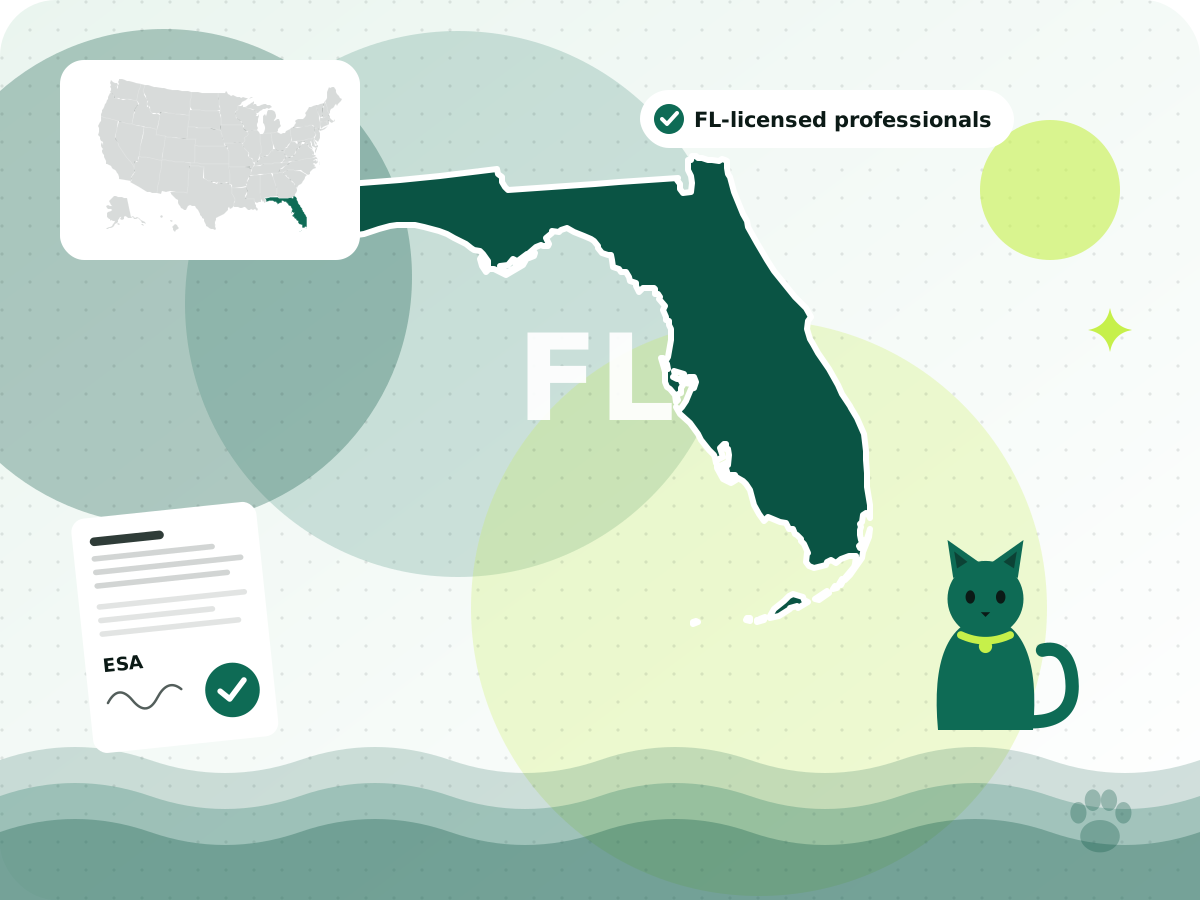
The Florida Fair Housing Act (Fla. Stat. §§ 760.20–760.37) prohibits housing discrimination because of disability. Complaints are investigated by the Florida Commission on Human Relations, and tenants can also file with HUD. Some counties and cities have local fair housing offices as well.
In a May 22, 2026 memo, HUD confirmed it had withdrawn its 2020 assistance-animal notice (FHEO-2020-01) and related earlier ESA guidance, and said it will generally find reasonable cause only for animals individually trained to perform disability-related tasks. The Fair Housing Act and its regulations are unchanged, private lawsuits remain available, and state law is unaffected. That matters in Florida, because the state has its own statute expressly protecting people with a disability-related need for an emotional support animal.
Florida's 2020 law (SB 1084, Chapter 2020-76, effective July 1, 2020) created Fla. Stat. § 760.27. It prohibits housing discrimination against a person with a disability or disability-related need for an emotional support animal and states that the person may not be required to pay extra compensation for the animal. A housing provider may request reliable information supporting the disability and the need for the animal when these are not readily apparent, but may not ask for a diagnosis or medical records, and may require proof of state or local licensing and vaccinations. A registration or certificate from a website, by itself, is not enough. The tenant is liable for any damage the ESA causes.
Section 760.27 also addresses who may write documentation. Supporting information is considered reliable only if the practitioner has personal knowledge of the person's disability and is acting within the scope of his or her practice. Documentation from a practitioner licensed in another state is acceptable only if that practitioner has provided in-person care to the tenant at least once, while Florida-licensed telehealth providers may provide documentation based on personal knowledge. Separately, Fla. Stat. § 817.265 makes falsifying, or knowingly providing fraudulent, information or documentation for an emotional support animal a second-degree misdemeanor, with 30 hours of community service for a disability organization. Florida has no state waiting period, so if a Florida-licensed mental health professional evaluates you and you qualify, the letter can be delivered the same day.
Condominium and HOA living is central to Florida housing. In Miami, Fort Lauderdale, Naples and along the Gulf Coast, many renters lease units in condo buildings where both the owner and the association must handle an accommodation request, and association pet limits should not be applied automatically to an approved ESA. Florida also has many 55-plus communities, from The Villages to coastal retirement complexes, with their own rules. Student markets around the University of Florida in Gainesville, Florida State in Tallahassee and UCF in Orlando are competitive, and military families rent near bases in Pensacola, Jacksonville, Tampa and the Panhandle.
Hurricanes are a practical concern. Keep a copy of your letter and your animal's vaccination and license records with your lease, plan for pet-friendly evacuation shelters, and tell your landlord how you will handle the animal if the building is evacuated. Because § 760.27 bars extra compensation, an approved ESA should not trigger pet rent, pet fees or pet deposits, but you are responsible for actual damage. A provider may deny a specific animal that poses a direct threat to others or would cause substantial physical damage. Vacation rentals in Orlando, the Keys and beach towns may be treated differently from ordinary leases.
A psychiatric service dog is individually trained to perform tasks related to a mental health disability. Florida's service animal statute, Fla. Stat. § 413.08, defines a service animal as one trained to do work or perform tasks directly related to a person's disability, states that providing emotional support or comfort does not count as work or tasks, and makes knowingly misrepresenting yourself as using a service animal a second-degree misdemeanor. Businesses may ask only whether the dog is required because of a disability and what task it performs. A PSD letter does not grant public access, and ESAs have no public-access rights at theme parks, beaches or restaurants.
A PSD letter can support a housing request, which HUD now treats as presumptively reasonable for individually trained animals. Airlines stopped carrying emotional support animals in 2021 but accept trained service dogs. For flights out of Orlando, Miami or Tampa, you complete the U.S. Department of Transportation Service Animal Air Transportation Form yourself, and a mental health professional's letter can help you answer it accurately.
If a housing provider refuses a reasonable accommodation without a valid reason, you can contact HUD Office of Fair Housing and Equal Opportunity, a local fair housing organization, or a housing attorney. Deadlines apply, so act promptly.
Last reviewed: October 9, 2026. Laws change; this page is general information, not legal advice.
There is no official national ESA registry, and online “registrations,” ID cards and certificates carry no legal weight. Registering your emotional support animal with your housing provider means giving them reliable documentation and a written accommodation request.
Every ESA evaluation for Florida residents is completed by a mental health professional licensed in the patient’s state, after a genuine telehealth evaluation.
Medical Doctor (M.D.)
Physician on our team who completes ESA evaluations and helps patients understand how their letter works for housing.
Mental health professionalMedical Doctor (M.D.)
Physician on our team who completes ESA evaluations and explains each patient's documentation and next steps clearly.
Mental health professionalEach pin sits on the city’s real location, and each list entry shows the outline of its county. Because the visit happens by video or phone, the FL-licensed professional you meet can help you just the same in Jacksonville as in Fort Lauderdale, or anywhere in between.
Section 760.27, created in 2020, protects people with a disability or disability-related need for an emotional support animal in housing. It sets out what documentation a landlord may request, bars extra charges for the animal and makes the tenant liable for damage.
No. Fla. Stat. 760.27 says a person with a disability-related need for an emotional support animal may not be required to pay extra compensation for the animal. You are still liable for any damage it causes.
No. Under 760.27 a landlord may request reliable information supporting your disability and need for the animal when these are not apparent, but may not request a diagnosis or medical records.
Only in limited cases. Section 760.27 accepts out-of-state documentation only if that practitioner has provided in-person care to you at least once. We connect you with a Florida-licensed mental health professional instead.
Yes, when it comes from a Florida-licensed practitioner who has personal knowledge of your disability-related need. Florida law allows telehealth providers to supply this documentation.
Yes. Fla. Stat. 817.265 makes falsifying or knowingly providing fraudulent ESA information or documentation a second-degree misdemeanor, with 30 hours of community service.
No. Florida law says a registration or certificate from a website is not, by itself, sufficient documentation. We do not sell registrations, certificates or ID cards.
The Florida Commission on Human Relations investigates complaints under the Florida Fair Housing Act. You can also file with HUD, and some counties have local fair housing offices.
HUD's May 22, 2026 memo changed federal enforcement, but state law is unaffected. Florida's 760.27 continues to protect tenants with a disability-related need for an emotional support animal, and private lawsuits remain available.
Condo associations are covered by Florida's fair housing law and must consider reasonable accommodations. A weight limit should not be applied automatically to an approved ESA, though a specific animal that poses a direct threat can be denied.
Age-restricted communities are still generally covered by disability fair housing protections. They should evaluate your request under 760.27 and the Fair Housing Act.
Keep your letter and vaccination records with your important papers, and locate a pet-friendly shelter in advance. General-population shelters may treat ESAs differently from trained service dogs.
No. Public access depends on the dog's individual task training under the ADA and Fla. Stat. 413.08. ESAs have no public-access rights.
Florida has no waiting period. If a Florida-licensed mental health professional evaluates you and you qualify, the letter can be delivered the same day; if not, you receive a full refund.
Pick a time that suits you; booking is open 24/7.
About 10 minutes of questions about how you’ve been feeling.
Video or phone. Your signed letter by email right after the call, if you qualify.
From$129up to 2 animals · $199 for 3 or more
Book my evaluationCheck if I qualify firstA Florida-licensed mental health professional makes the decision after a real evaluation. If you don’t qualify, you get a full refund.
Keep reading
Answer five quick questions to see whether an ESA evaluation is a good next step. It takes about a minute and nothing is saved.