Dr. Gaurav Patel, M.D.
Medical Doctor (M.D.)
Physician on our team who completes ESA evaluations and helps patients understand how their letter works for housing.
Mental health professionalWhether you rent a high-rise in Houston, a garden apartment in San Antonio or a duplex near campus in Austin, Texas and federal fair housing law require landlords to consider reasonable accommodations, including emotional support animals, for people with disabilities. Here is what Texas renters need to know.
Medically reviewed by Dr. Johnathan Miller, M.D.Updated October 9, 2026
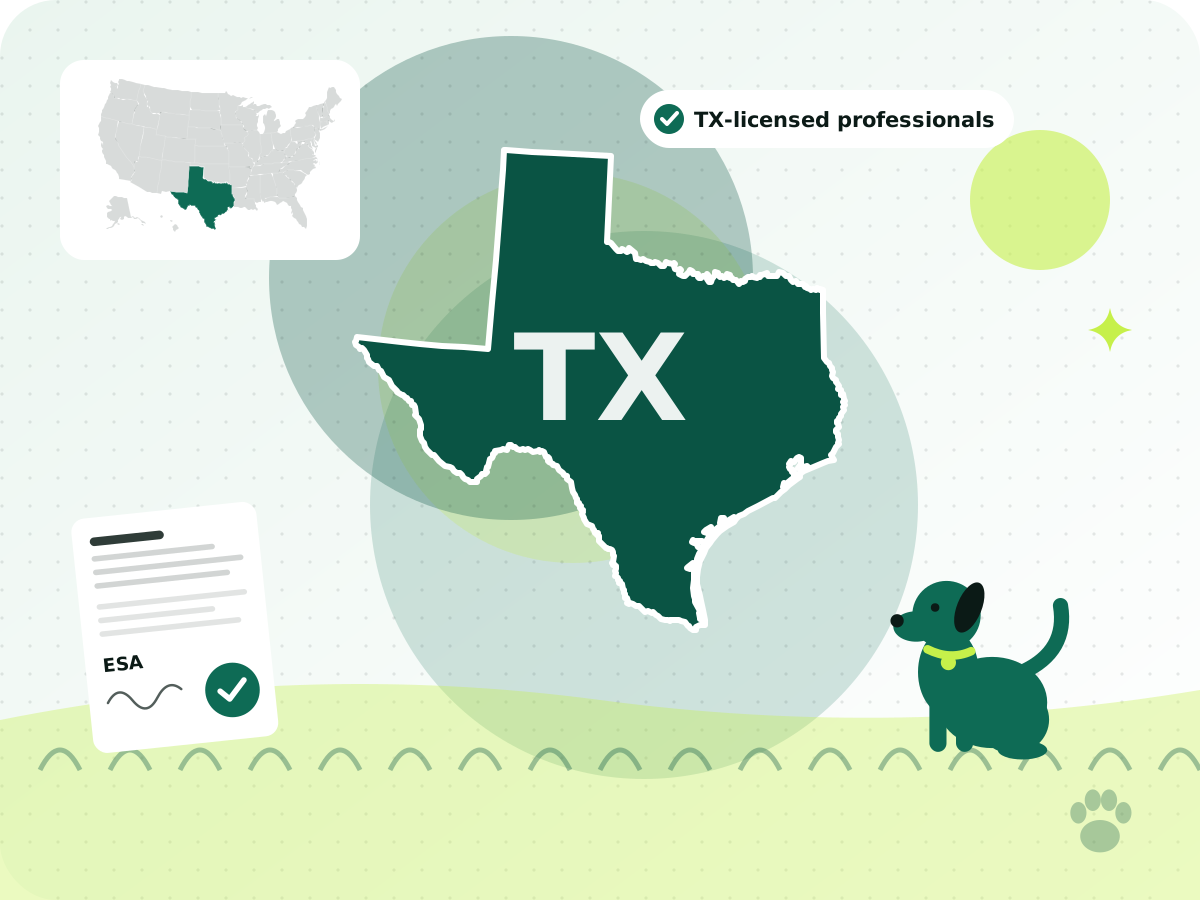
Texas has its own state version of federal fair housing law, the Texas Fair Housing Act, found in Chapter 301 of the Texas Property Code. Like the federal Fair Housing Act, it prohibits housing discrimination based on disability and requires housing providers to make reasonable accommodations in rules and policies when needed for a person with a disability to use and enjoy a home. Waiving a no-pets policy, a pet weight limit or a breed restriction for an emotional support animal is a classic example.
State complaints are handled by the Texas Workforce Commission Civil Rights Division (TWC-CRD). The Texas Department of Housing and Community Affairs says you have one year from the alleged discrimination to file an administrative complaint. Several cities also run their own fair housing offices, including Austin, Dallas, Fort Worth, Corpus Christi and Garland. HUD's regional office in Fort Worth also accepts federal complaints, though since May 2026 HUD generally pursues only cases involving individually trained animals.
Texas does not have a separate statute that sets special requirements for ESA letters, such as a waiting period or minimum treatment relationship. That means the Texas Fair Housing Act and the federal Fair Housing Act govern ESA requests. When a disability is not obvious, a housing provider may request reliable information confirming that you have a disability and a disability-related need for the animal. In practice, documentation from a licensed health care professional who has evaluated you is the most widely accepted form, while certificates or registrations purchased online, on their own, do not show a disability-related need.
A valid letter from our network is written on the mental health professional's letterhead, signed by a mental health professional licensed in Texas, and lists their license type, number and state. It confirms your disability-related need without disclosing your diagnosis.
Texas does penalize misrepresentation. Under Texas Human Resources Code 121.006, intentionally or knowingly representing that an animal is an assistance animal or service animal when it is not specially trained or equipped to help a person with a disability is a misdemeanor under Texas law. Honest documentation and accurate descriptions of your animal keep you on the right side of the law.
HUD withdrew its 2020 assistance animal notice (FHEO-2020-01) and its 2013 notice on service animals and assistance animals (FHEO-2013-01), effective September 17, 2025. In a May 22, 2026 enforcement memo, HUD's Office of Fair Housing and Equal Opportunity said it will find reasonable cause only where an animal is individually trained to perform work or tasks directly related to the person's disability, and that waiving a pet policy for an untrained emotional support animal is not presumptively reasonable. A HUD complaint about an untrained ESA is therefore much less likely to succeed than before. The Fair Housing Act and HUD's regulations did not change, the memo states that private lawsuits are unaffected, and HUD's Federal Register notice confirms that private civil actions may be filed within two years. The memo does not address state law.
Texas has no separate ESA statute, so Texas renters rely on the Texas Fair Housing Act (Property Code Chapter 301), which, like federal law, requires reasonable accommodations for people with disabilities. That statute did not change. The Texas Workforce Commission Civil Rights Division enforces it, although how state agencies respond to HUD's new approach may evolve, so file promptly and keep thorough records.
Texas renters often deal with large, professionally managed apartment communities. Many Texas leases come with a separate animal addendum, and big management companies frequently use online portals to review accommodation requests. Submit your letter through the official channel and keep a copy. Pet rent, pet fees and pet deposits generally should not apply once an accommodation is approved, but rules vary, and you remain responsible for actual damage.
In suburbs such as Plano, Frisco, Katy and The Woodlands, many homes are in master-planned communities governed by HOAs. HOAs are generally subject to reasonable accommodation requirements, so a rule limiting the number or size of pets may need to be waived for an approved ESA.
College towns have their own patterns. Students at UT Austin, Texas A&M in College Station, Texas Tech in Lubbock, UNT and TWU in Denton, and UTEP in El Paso often rent in private student complexes with pre-leasing a year ahead, so request accommodations early. Military families near Fort Cavazos in Killeen, Fort Bliss in El Paso and Joint Base San Antonio who rent off post are covered by the same rules. And with Texas heat and Gulf Coast storm season, it is worth planning how your ESA will be cared for during summer outages or evacuations.
A psychiatric service dog is individually trained to perform tasks for a person with a mental health disability, such as alerting to rising anxiety, interrupting nightmares, or performing deep pressure therapy. Under the ADA and Texas Human Resources Code Chapter 121, the right to bring a service animal into public places comes from that training, not from a letter, vest or ID card. Businesses may ask only whether the dog is needed because of a disability and what task it performs.
A PSD letter documents your disability-related need for housing and supports the information you give on the U.S. Department of Transportation service animal form that airlines may require. Since 2021 airlines no longer accommodate emotional support animals, so an ESA flying out of DFW, Houston or Austin usually travels under pet policies.
We never sell registrations or certificates, and if the mental health professional determines you do not qualify, you get a full refund.
If a housing provider refuses a reasonable accommodation without a valid reason, you can contact Texas Workforce Commission Civil Rights Division, a local fair housing organization, or a housing attorney. Deadlines apply, so act promptly.
Last reviewed: October 9, 2026. Laws change; this page is general information, not legal advice.
There is no official national ESA registry, and online “registrations,” ID cards and certificates carry no legal weight. Registering your emotional support animal with your housing provider means giving them reliable documentation and a written accommodation request.
Every ESA evaluation for Texas residents is completed by a mental health professional licensed in the patient’s state, after a genuine telehealth evaluation.
Medical Doctor (M.D.)
Physician on our team who completes ESA evaluations and helps patients understand how their letter works for housing.
Mental health professionalMedical Doctor (M.D.)
Physician on our team who completes ESA evaluations and explains each patient's documentation and next steps clearly.
Mental health professionalEach pin sits on the city’s real location, and each list entry shows the outline of its county. Because the visit happens by video or phone, the TX-licensed professional you meet can help you just the same in Houston as in Corpus Christi, or anywhere in between.
In a May 2026 memo, HUD confirmed it had withdrawn its 2020 assistance animal guidance and now generally pursues only cases involving individually trained animals. The Texas and federal Fair Housing Acts themselves did not change, and private lawsuits remain available, but enforcement for untrained ESAs is less certain than before.
Texas does not have a separate statute setting extra requirements for ESA letters, such as a waiting period. The Texas Fair Housing Act (Property Code Chapter 301) and the federal Fair Housing Act govern ESA requests in housing.
Yes. Texas Human Resources Code 121.006 makes it a misdemeanor to knowingly represent that an animal is an assistance or service animal when it is not specially trained or equipped to help a person with a disability.
You can file with the Texas Workforce Commission Civil Rights Division within one year. HUD also takes complaints, but since May 2026 it generally pursues only cases involving individually trained animals. Some cities, including Austin, Dallas, Fort Worth, Corpus Christi and Garland, also have local fair housing offices.
Yes, if the Texas-licensed mental health professional determines you qualify. Texas does not impose a waiting period, so your letter can be delivered the same day once approved.
Pet rent, pet fees and pet deposits generally should not apply once an accommodation is approved, but rules vary. Texas law does not specifically address fees for ESAs, so ask in writing for them to be waived. You are still responsible for any real damage the animal causes.
A landlord can ask you to follow reasonable rules about animal behavior, waste and damage, and pet fees or deposits generally should not apply once an accommodation is approved, but rules vary. If the addendum includes pet charges, ask in writing for those terms to be waived as part of your accommodation.
HOAs are generally covered by fair housing reasonable accommodation rules. If your HOA limits the number, size or type of pets, you can request an exception for an approved emotional support animal.
University-owned housing generally has to consider accommodation requests, but each school has its own process and timeline. Private student complexes near campus are subject to fair housing rules too; submit requests before signing or early in pre-leasing.
Yes. Off-post private rentals in Killeen, Harker Heights or El Paso follow the same fair housing rules as any Texas rental. On-post or privatized housing has its own process through the housing office.
Breed rules are a common subject of accommodation requests, and a landlord should look at your specific animal rather than its breed alone. A documented insurance problem may sometimes be a legitimate concern, so ask the landlord to put it in writing and consider legal advice.
Yes, but only on narrow grounds, such as the specific animal posing a direct threat or causing substantial damage that cannot be reduced, an undue burden, or the property being exempt, like some small owner-occupied buildings.
No letter grants public access. Under the ADA and Texas Human Resources Code Chapter 121, a psychiatric service dog has public access because of its task training.
Our ESA letter for housing is $129 for up to two pets and $199 for three or more. You receive a full refund if the mental health professional determines you do not qualify.
Pick a time that suits you; booking is open 24/7.
About 10 minutes of questions about how you’ve been feeling.
Video or phone. Your signed letter by email right after the call, if you qualify.
From$129up to 2 animals · $199 for 3 or more
Book my evaluationCheck if I qualify firstA Texas-licensed mental health professional makes the decision after a real evaluation. If you don’t qualify, you get a full refund.
Keep reading
Answer five quick questions to see whether an ESA evaluation is a good next step. It takes about a minute and nothing is saved.