Dr. Gaurav Patel, M.D.
Medical Doctor (M.D.)
Physician on our team who completes ESA evaluations and helps patients understand how their letter works for housing.
Mental health professionalMinnesota is one of the few states with its own statute on service and support animal documentation in rental housing, and it bars landlords from charging extra fees for approved animals. We connect you with a Minnesota-licensed mental health professional whose evaluation fits that law.
Medically reviewed by Dr. Johnathan Miller, M.D.Updated October 9, 2026
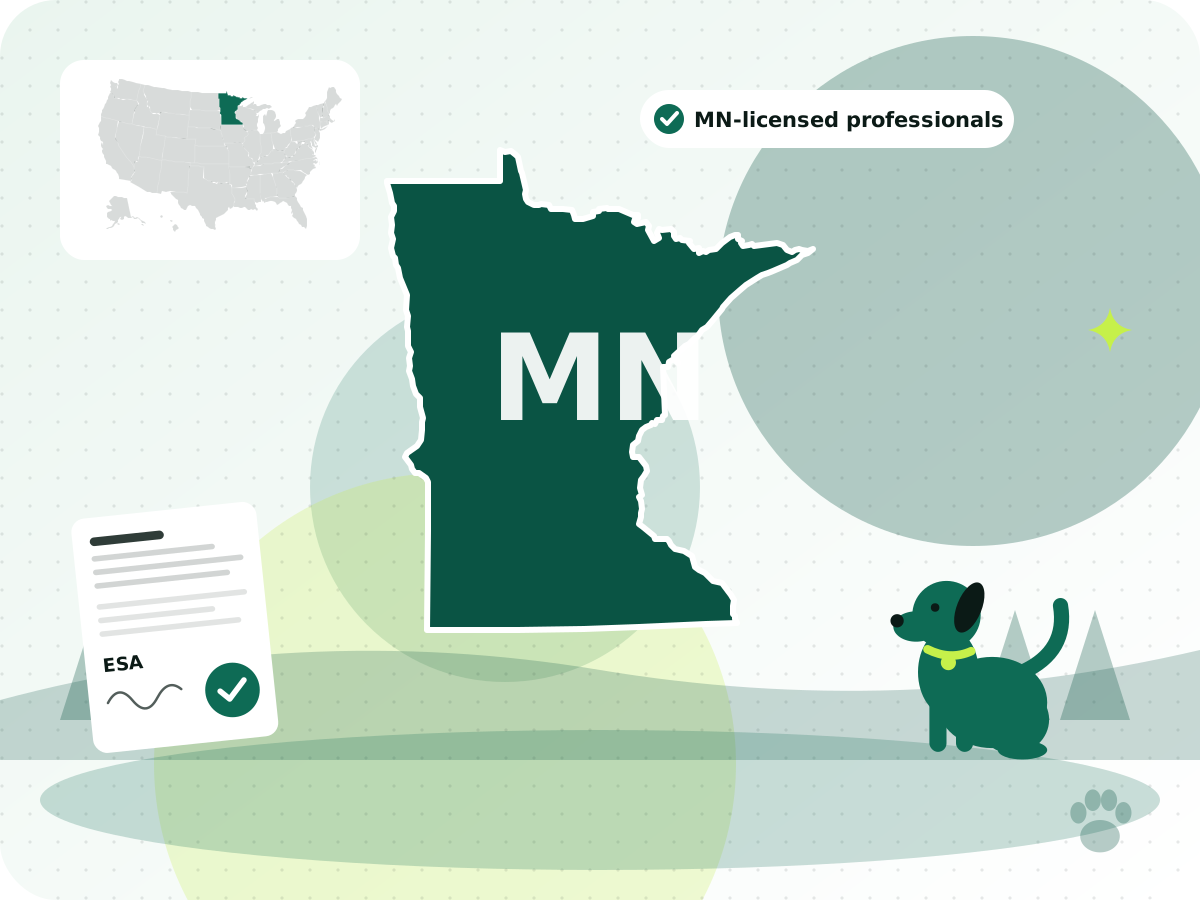
Housing discrimination based on disability is prohibited by the Minnesota Human Rights Act, Minn. Stat. chapter 363A, which includes a duty to make reasonable accommodations. Complaints are handled by the Minnesota Department of Human Rights (MDHR), and some cities, including Minneapolis and Saint Paul, have their own civil rights offices as well.
On May 22, 2026, HUD issued an enforcement memo confirming the withdrawal of its 2020 and 2013 assistance animal notices (FHEO-2020-01 and FHEO-2013-01), effective September 17, 2025, and saying federal investigators would pursue cases mainly involving animals individually trained to perform tasks. That memo did not amend the Fair Housing Act, did not end private lawsuits, and does not override Minnesota statutes. In Minnesota, the more concrete rules for renters with assistance animals are written into state law, as explained below.
Minnesota's landlord-tenant chapter contains Minn. Stat. § 504B.113, Service and Support Animal Documentation, enacted in 2021 and amended in 2024. It defines a support animal as one that provides emotional support alleviating one or more identified symptoms or effects of a person's disability and that does not need task training. Key points:
Minnesota does not impose a waiting period. A letter from a Minnesota-licensed mental health professional who conducts a genuine evaluation, lists their license information, and describes your disability-related need without naming a diagnosis fits this framework. Separately, Minn. Stat. § 609.833 makes it a petty misdemeanor, and a misdemeanor for repeat violations, to intentionally misrepresent an animal as a service animal in a place of public accommodation.
Minnesota renters face long winters, big managed complexes in the Twin Cities suburbs, and plenty of older duplexes and fourplexes in Minneapolis and Saint Paul neighborhoods. Because § 504B.113 requires leases to disclose the no-fee rule, check your lease: many Minnesota landlords now include a service and support animal clause. Student renters near the University of Minnesota, Minnesota State Mankato, St. Cloud State, and Minnesota State Moorhead should contact campus disability services for residence halls and give private landlords documentation well before move-in.
Rochester draws people relocating for medical care and work at Mayo Clinic, and many arrive on short timelines; having your documentation ready before you apply avoids delays. Up north around Duluth, the Iron Range, and lake country, cabins and seasonal rentals are common, and a short-term vacation stay may not be treated like a residential lease. Even with an approved animal you remain responsible for actual damage, and a landlord can refuse a specific animal that poses a direct threat or would cause an undue burden.
A psychiatric service dog is individually trained to perform tasks for a person with a mental health disability. In Minnesota restaurants, shops, and on Metro Transit, access comes from the ADA and the dog's training, not from a letter, and staff may ask only whether the dog is required because of a disability and what task it performs. Misrepresenting a pet as a service animal in public can bring a penalty under § 609.833.
A PSD letter from a licensed mental health professional supports a housing accommodation, and trained task animals remain within HUD's federal enforcement focus after the 2026 memo. It also helps you complete the U.S. DOT Service Animal Air Transportation Form for flights from MSP. Airlines have not accommodated emotional support animals since 2021. We do not sell registry listings, vests, or ID cards.
If a housing provider refuses a reasonable accommodation without a valid reason, you can contact Minnesota Department of Human Rights (MDHR), a local fair housing organization, or a housing attorney. Deadlines apply, so act promptly.
Last reviewed: October 9, 2026. Laws change; this page is general information, not legal advice.
There is no official national ESA registry, and online “registrations,” ID cards and certificates carry no legal weight. Registering your emotional support animal with your housing provider means giving them reliable documentation and a written accommodation request.
Every ESA evaluation for Minnesota residents is completed by a mental health professional licensed in the patient’s state, after a genuine telehealth evaluation.
Medical Doctor (M.D.)
Physician on our team who completes ESA evaluations and helps patients understand how their letter works for housing.
Mental health professionalMedical Doctor (M.D.)
Physician on our team who completes ESA evaluations and explains each patient's documentation and next steps clearly.
Mental health professionalEach pin sits on the city’s real location, and each list entry shows the outline of its county. Because the visit happens by video or phone, the MN-licensed professional you meet can help you just the same in Minneapolis as in Moorhead, or anywhere in between.
Yes. Minn. Stat. § 504B.113 governs service and support animal documentation in rental housing. It lets landlords request documentation from a licensed professional and prohibits extra fees or deposits for approved animals.
The law lists providers such as physicians, physician assistants, nurses, psychologists, mental health professionals, social workers, and counselors. It excludes people whose business is primarily selling animal certifications.
No. Section 504B.113 bars additional fees or deposits for an approved service or support animal and requires leases to disclose that rule. You remain responsible for any actual damage.
No. Minnesota does not require a set relationship length before a mental health professional writes documentation. If a Minnesota-licensed mental health professional approves you, your letter can be delivered the same day.
Under § 504B.113, tenants may not knowingly misrepresent a disability or submit fraudulent documentation. A landlord may deny the request or application, and lease-violation evictions remain possible.
Minn. Stat. § 609.833 makes it a petty misdemeanor to intentionally misrepresent an animal as a service animal in a place of public accommodation, and a misdemeanor for a second or later violation.
The Minnesota Department of Human Rights accepts discrimination charges under the Minnesota Human Rights Act. Minneapolis and Saint Paul also have local civil rights offices.
No. HUD's memo changed federal enforcement priorities, but Minnesota's statutes, including § 504B.113 and the Human Rights Act, still apply on their own terms.
Residence halls handle requests through campus disability resources with their own process and timelines. Off-campus landlords in Dinkytown or Stadium Village follow § 504B.113.
You can book online any time, and if a Minnesota-licensed mental health professional approves you, the letter can be issued the same day. Having it ready before you apply helps with tight relocation timelines.
Residential leases are covered by fair housing law and § 504B.113. Short-term vacation rentals are often treated differently, so confirm the type of rental before relying on a request.
No. Public access comes from the dog's individual task training under the ADA. A PSD letter supports housing requests and airline paperwork.
Airlines stopped accommodating emotional support animals in 2021, so ESAs fly under pet policies. Trained psychiatric service dogs use the U.S. DOT Service Animal Air Transportation Form.
$129 for up to two pets or $199 for three or more, with a full refund if the mental health professional determines you do not qualify.
Pick a time that suits you; booking is open 24/7.
About 10 minutes of questions about how you’ve been feeling.
Video or phone. Your signed letter by email right after the call, if you qualify.
From$129up to 2 animals · $199 for 3 or more
Book my evaluationCheck if I qualify firstA Minnesota-licensed mental health professional makes the decision after a real evaluation. If you don’t qualify, you get a full refund.
Keep reading
Answer five quick questions to see whether an ESA evaluation is a good next step. It takes about a minute and nothing is saved.